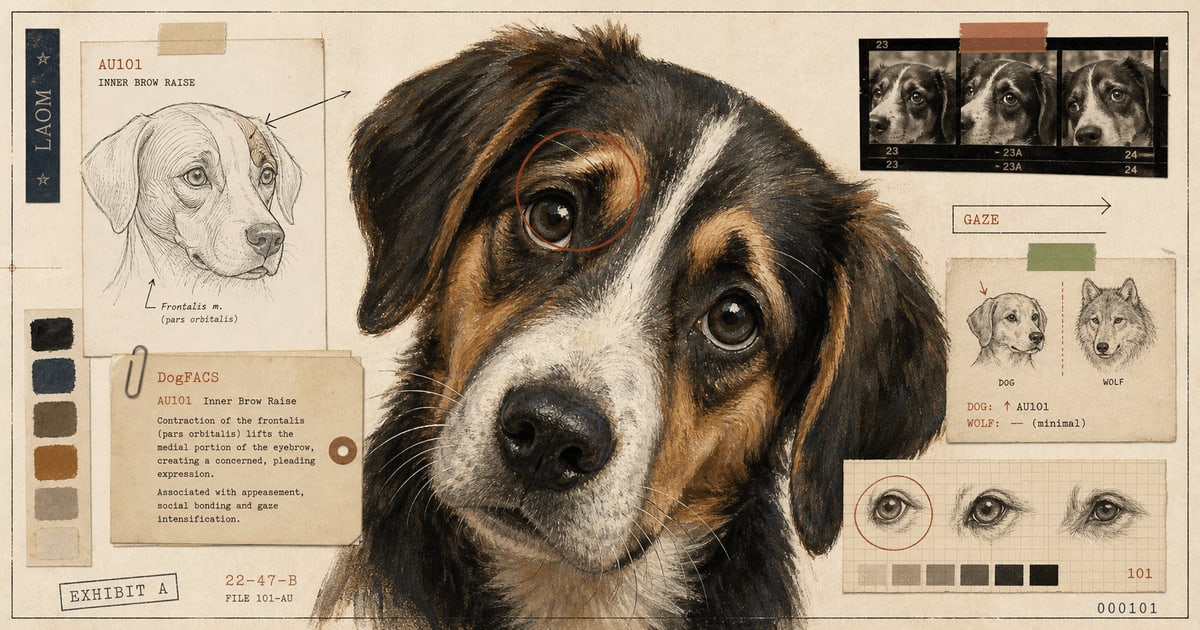
Your dog’s eyebrows are not doing this by accident. Or at least, not entirely.
The expression people call “puppy dog eyes” has a real anatomical basis. Researchers usually describe the visible movement as AU101, the inner brow raiser. One muscle associated with that movement is the levator anguli oculi medialis, mercifully shortened to LAOM by people who have other things to do today.
When the inner brow lifts, the eyes look larger, softer, and more infant-like. Humans notice. We are embarrassingly available to a face that says, “I have never eaten dinner, possibly ever.”
The science is more interesting than the meme. The look is anatomy, attention, domestication, and the long practical history of dogs getting good at being seen by people.
The Muscle Behind the Look
A 2019 paper in Proceedings of the National Academy of Sciences compared facial muscle anatomy in domestic dogs and gray wolves. The researchers found that the LAOM was routinely present as an independent muscle in the dogs they examined, while in the wolf specimens it was typically represented only by scant muscle fibers and connective tissue.
They also compared behavior. In short social interactions with a human, dogs produced the inner brow raise more often and with higher intensity than wolves. The highest-intensity versions appeared only in dogs in that study.
That is the part that makes the phrase “puppy dog eyes” less silly than it sounds. The look is a measurable facial movement, tied to soft tissue around the eye.
Small caveat, because science earns its keep by ruining overly tidy stories: the anatomical sample in that 2019 paper was small, with six domestic dogs and four gray wolves. Strong result, not the final word carved into a stone tablet.
Why Humans Respond to It
The inner brow raise changes the apparent shape of the eye. It can make the orbital area look taller, which gives the face a more juvenile appearance. The technical term is paedomorphic, meaning adult features that resemble juvenile ones.
Humans tend to respond strongly to juvenile facial cues. We notice big eyes. We notice raised brows. We also read the inner brow raise as something close to sadness in human faces, which may trigger a nurturing response.
This does not mean your dog has a flowchart labeled “Step 1: look vulnerable. Step 2: acquire cheese.” It means dogs and humans have spent a long time in each other’s social weather, and faces became part of that weather.
A 2013 PLOS ONE study looked at shelter dogs and found that dogs who produced AU101 more often during a brief interaction with a stranger were rehomed more quickly. The authors treated shelter rehoming speed as a rough proxy for human selection, and they were careful about limitations. The finding was exploratory, not a universal rule for every dog, every adopter, and every shelter.
Still, it points in a useful direction: humans may preferentially respond to dogs whose faces create that helpless, infant-like impression. We are not as subtle as we think.
It Is Also About Attention
The eyebrow movement is not only anatomy. Dogs also seem sensitive to whether a person is paying attention.
A 2017 Scientific Reports study tested whether dogs produced facial expressions differently when a human was facing them versus turned away, and whether the presence of food changed the behavior. Dogs produced more facial movements when the human was attentive. Food did not have the same effect.
That does not prove dogs are consciously acting out a tiny melodrama for us. It does suggest their facial expressions are more than automatic emotional leakage. Social context matters.
In normal household terms, your dog may look different when they are looking at you than when they are looking at the wall, the floor, or a suspiciously promising cabinet. Revolutionary, but someone had to fund it.
The Newer Nuance
There is a newer wrinkle worth including. A 2024 brief report in Biology examined facial muscle morphology across 10 canid specimens and found that LAOM and RAOL, another eye-area muscle discussed in dog-human communication, were not unique to domestic dogs.
That does not erase the 2019 dog-wolf findings. It complicates the simple version.
The cleanest interpretation is not “only dogs have the puppy dog eye muscle.” It is more careful: domestic dogs appear to use this eye-area expression in human-directed communication, and some anatomical and behavioral differences between dogs and wolves may have been emphasized through domestication. Other canids may also have related muscles, which means the evolutionary story is probably wider than one species, one muscle, one cute face.
Good. Nature is allowed to be more complicated than a caption.
Why Artists Look for the Brow
For a custom dog portrait, the raised inner brow matters because it changes the whole expression.
It can make a dog look softer, more attentive, younger, worried, curious, or gently dramatic. In some dogs, that brow lift is the exact look their family recognizes. Not the breed. Not the coat color. The look.
An artist studying a reference photo will pay attention to:
- The height and shape of each eye
- Whether one inner brow is raised more than the other
- Wrinkles or folds above the eye
- The angle of the gaze
- Catchlights that make the eyes feel alive
- Whether the expression is soft, alert, anxious, skeptical, or calm
These are small details, but they carry identity. Move the brow too high and the dog may look startled. Flatten it and the expression can go dull. Make both eyes perfectly symmetrical and suddenly the portrait looks less like a living animal and more like a committee approved it.
That is why “cute” is not the goal. Accurate is the goal. Cute can come along if it has the paperwork.
How to Choose a Reference Photo
If your dog has a classic puppy dog eyes expression, send a photo that shows it clearly. Eye-level photos usually work best because they preserve the real shape of the face. Natural light helps the artist see the brow, eyelids, catchlights, and fur direction around the eyes.
Useful reference notes are simple:
- This is her worried dinner face
- Please keep the one raised eyebrow
- His eyes are softer in photo 2
- Photo 1 has the best expression, photo 3 has the best coat color
You do not need to write a behavioral dissertation. The artist needs the specific visual clue that makes the portrait feel like your dog.
Also, do not force the expression if it is not your dog. Some dogs do puppy dog eyes. Some dogs look noble. Some look permanently amused. Some look like they have been asked to review a quarterly report and found the methodology lacking.
Use the expression your household knows.
What This Means for a Portrait
The science gives us a better way to talk about likeness. A dog portrait is not only about getting the muzzle length and coat markings right, although those matter. It is also about the social face: the eyes, brows, attention, and expression the owner recognizes instantly.
That is why the eyes get the closest attention before anything is finalized. Not to exaggerate emotion, and not to turn every dog into a sad cartoon. The job is to preserve the expression that belongs to that animal.
Every Pet on Canvas portrait is custom made from your photo, with a proof in 2-3 business days and unlimited revisions before final approval. Digital portraits start at $24.99, and custom canvases start at $49.99.
If you are ordering a portrait, send the photo where the eyes feel most like your dog. If another photo shows the coat color or markings better, send that too. The artist can use both.
Puppy dog eyes may have evolutionary history behind them. In a portrait, they have a simpler job: making the finished artwork feel like the dog who has been quietly managing your emotional life from the couch.
Sources
- Kaminski et al., “Evolution of facial muscle anatomy in dogs”, Proceedings of the National Academy of Sciences, 2019.
- Waller et al., “Paedomorphic Facial Expressions Give Dogs a Selective Advantage”, PLOS ONE, 2013.
- Kaminski et al., “Human attention affects facial expressions in domestic dogs”, Scientific Reports, 2017.
- Sexton et al., “Raising an Eye at Facial Muscle Morphology in Canids”, Biology, 2024.
Welcome perk
Free expedited delivery on your first portrait
Get your digital proof in 1-2 business days instead of 2-3, free on your first portrait. Normally a $10 upgrade.
No spam. Just the perk and the occasional new style or guide.
Check your inbox for your code.